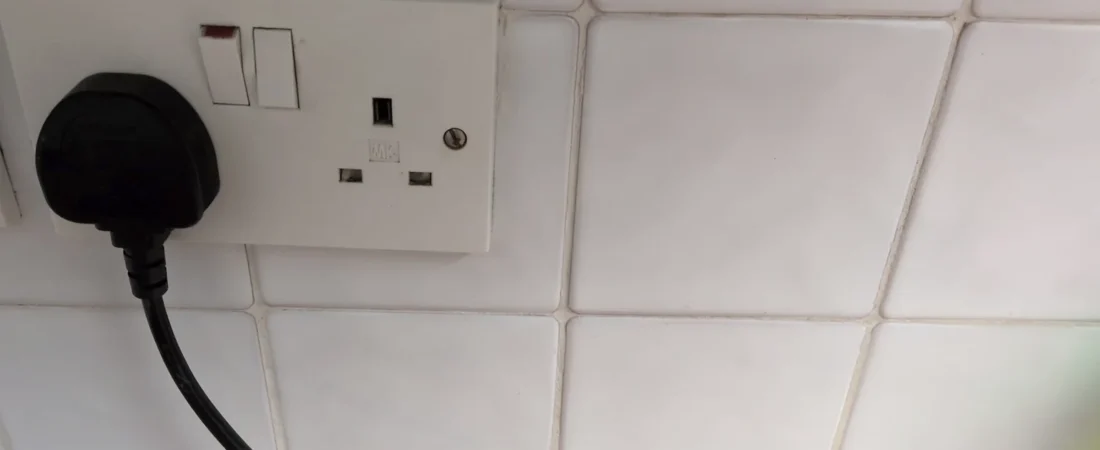
The short answer
If your appliance already has a 13-amp plug on it — a mini oven, air fryer, countertop induction hob, combi microwave, slow cooker — then yes, you can run it on an extension lead, as long as you do four things:
- Use one lead and one appliance. Not a chain, not a lead shared with the kettle.
- Use a lead rated 13 A and fused, bought from a shop, not a marketplace seller.
- Unwind it fully if it’s on a cable reel.
- Check the appliance’s manual doesn’t forbid it.
If it’s a full-size cooker or a built-in oven meant to be wired into a circuit, the answer is no — not “be careful”, but “this cannot be done safely”. A single built-in oven is often 2.5–3 kW on its own; a cooker with a hob can pull 7 kW. That’s why they get a dedicated circuit and a fatter cable, and no extension lead changes that.
Before you plug anything in
- Never cut a moulded plug off to make an appliance fit an old socket, and never wire a fixed appliance onto a plug yourself. Both are an electrician’s job.
- Never plug an extension lead into another extension lead. Electrical Safety First: “Only use one socket extension device per socket.”
- Never run a cable reel wound up. Wound, its rating can fall as low as 3–4 A — a 3 kW oven will cook the reel.
- Never fit a bigger fuse than the lead is rated for. The fuse is the part that’s supposed to fail.
- If a plug, socket or lead is hot, brown or scorched, stop using it.
Amps, volts and the 3 kW ceiling
The arithmetic is the whole argument.
A UK plug fuse comes in 3 A and 13 A. Watts equal amps multiplied by volts, so on a 230-volt supply:
13 A × 230 V = 2,990 W ≈ 3 kW
That’s your ceiling, and the fuse is the weak link by design — it melts before the cable does. Pull more than about 3 kW and it blows, which is the fuse doing its job.
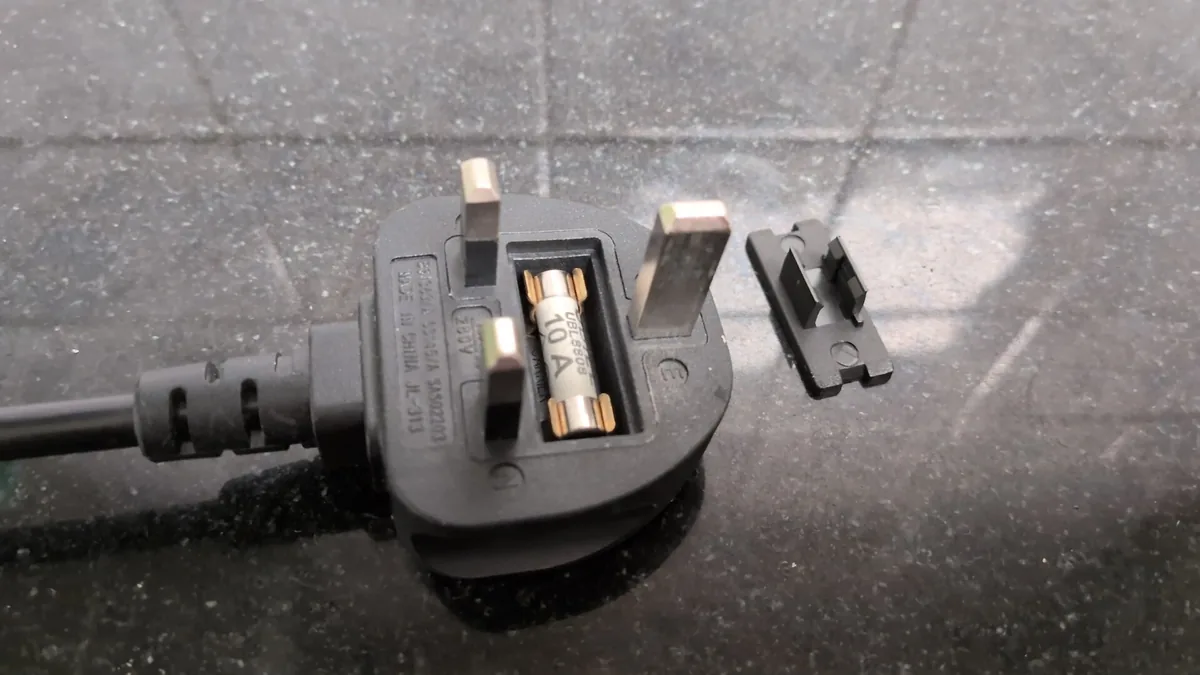
Electrical Safety First puts the same number in their plug guidance: appliances rated from 700 to 3,000 watts — “the maximum rating of a wall socket” — should carry a 13-amp fuse.
So a 2.2 kW countertop hob is 9.6 A. A 2.8 kW two-ring hob is 12.2 A: legal, but with nothing left over. A 3 kW kettle is 13 A on its own — acceptable only because it’s boiling for two minutes, not roasting for ninety.
The continuous-load catch nobody mentions
A socket labelled 13 A is not a promise that you can draw 13 A all afternoon.
In the IET’s engineering forum, where the people who work with BS 7671 answer questions, the position is blunt. From Maximum sustained current permitted from 13 amp plug?:
“13 amp plugs and sockets can not reliably and continually carry more than about 10 amps.”
And from a second thread: “10 amps seems to be about the sensible limit for standard types of so called 13 amp sockets, at least for long hour use.”
10 A at 230 V is 2.3 kW. That’s the number to design around for anything that runs an hour or more — and it’s why UK appliances are built the way they are. As that thread notes, most are limited to around 10 A, “apart from kettles which tend to be OK due to the very short” time they’re switched on.
Two things shrink the limit further, both from Electrical Safety First: older leads and most cable reels may be rated 10 A or less even though “most extension leads are rated at 13A”, and a reel that isn’t fully unwound has a rating “typically as low as 3 or 4A”.
So the honest answer isn’t “13 amps is fine”. It’s: keep a sustained load under about 10 A (2.3 kW), and don’t share that lead with anything else.
The fuse is sized for the appliance, not the cord
That arithmetic assumes the lead’s cable can carry the current. Ours is printed 3G0.75mm² — 0.75 mm², three cores — which BS 7671’s flexible-cord table (Table 4F3A) rates at 6 A. The appliance is a 1,300 W air fryer drawing about 5.7 A, so the lead is adequate, not undersized.
| Part of the lead | Rating | What it is actually protecting |
|---|---|---|
| Air fryer | 1,300 W (about 5.7 A) | Itself — nothing else in the chain |
| Flex, 0.75 mm² three-core | 6 A (1,380 W) | The appliance’s current, with 0.3 A to spare |
| Plug fuse, BS 1362 | 10 A (2,300 W) | The flex — but not until 16 A |
A BS 1362 fuse is not precise: its rated current is what it carries indefinitely, and its non-fusing current is 1.6 times that — a 10 A fuse sits there while 16 A flows. Between 6 A and 10 A it does nothing, while the conductor is already above its rating: a damaged section of flex can sit there for hours. Fuses answer gross faults, not the slow overload that damages cords.
Compliance is not the point. BS 1363-1 requires a BS 1362 fuse link, and its Table 2 pairs 0.75 mm² cord with a 7 A fuse — 13 A where the appliance’s characteristics need it — while clause 7.1(f) caps a moulded plug’s fuse rating at that table value. The demonstration stands on the arithmetic.
The fuse in the plug above is a sand-filled ceramic BS 1362 — the compliant construction: an opaque ceramic tube packed with quartz sand. The Office for Product Safety and Standards counts “insufficient granular filler” a defect. A glass-bodied cartridge is not a BS 1362 fuse, and Trading Standards warns such counterfeits “may explode violently”.
Both printings are on the same cord. G means the third core is a green/yellow earth, X means no earth core — and since the multiplication sign is often printed as X, one jacket can carry both. Strip a centimetre of sheath: green/yellow means the lead does have an earth conductor, and three identical cores on a 3G-printed lead would mean the marking is wrong.
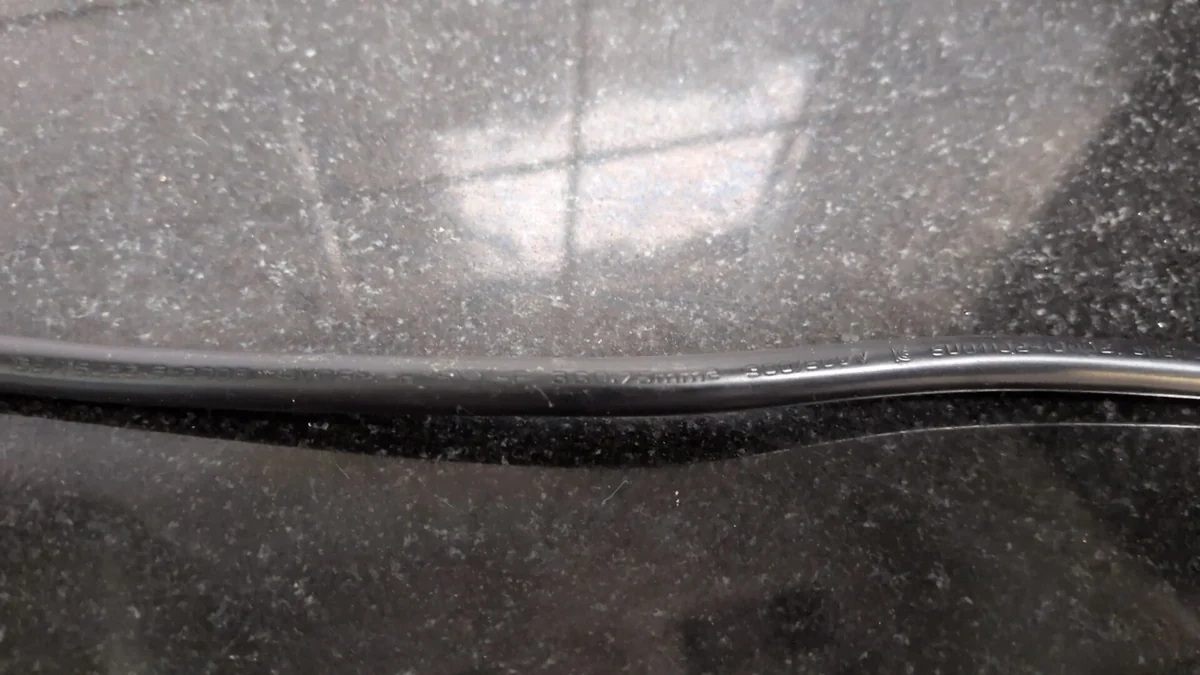
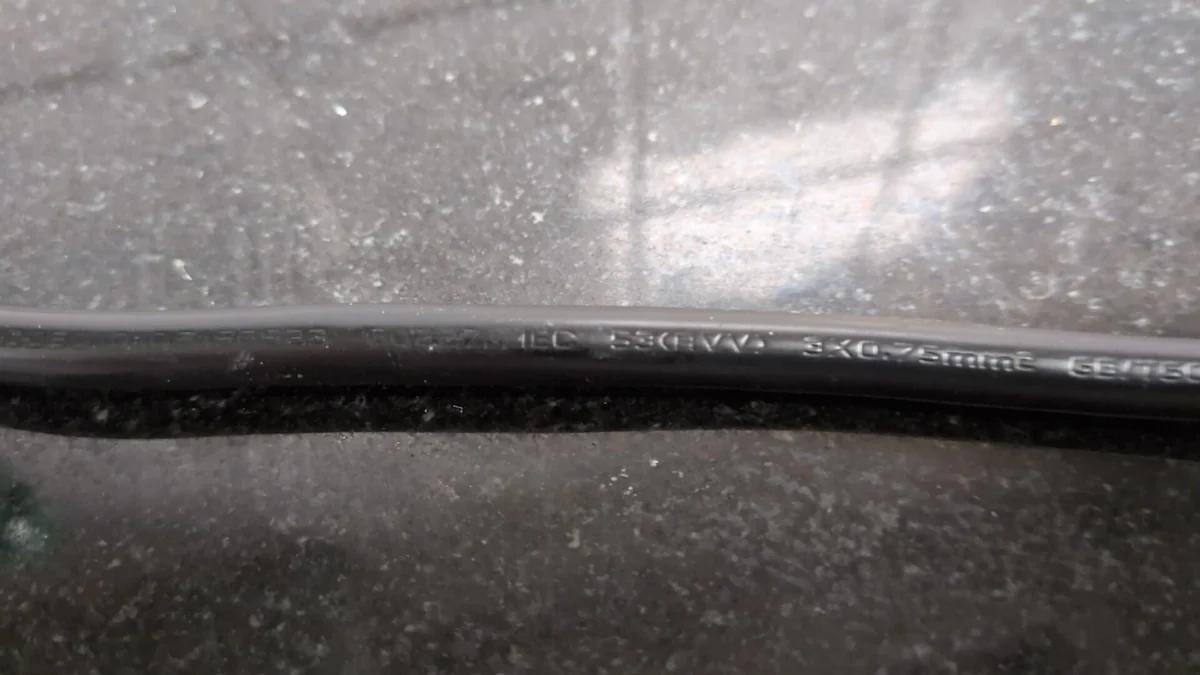
Check your own lead in one move: read the mm² figure printed on the jacket — 0.75 mm² is a 6 A, 1,380 W lead. For what else one socket can carry see the complete guide to 13 A cooking; for hobs that arrive with a 13 A plug, our 13 A plug-in induction hob guide.
What your appliances actually draw
Rated power figures are typical manufacturer ratings for this size of appliance; the number that governs your kitchen is on your appliance’s rating plate.
| Appliance | Typical rated power | Amps at 230 V | Headroom left on a 13 A fuse |
|---|---|---|---|
| Kettle (1.7 L) | 3,000 W | 13.0 A | 0 A — nothing else at the same time |
| Countertop induction hob (single ring) | 2,000–2,200 W | 8.7–9.6 A | 3.4–4.3 A |
| Two-ring or built-in 13 A induction hob | 2,800–3,000 W | 12.2–13.0 A | 0–0.8 A |
| Air fryer (4.5 L single drawer) | 1,400–1,800 W | 6.1–7.8 A | 5.2–6.9 A |
| Mini oven / countertop oven | 1,500–2,000 W | 6.5–8.7 A | 4.3–6.5 A |
| Combi microwave (grill or oven mode) | 1,000–1,700 W | 4.3–7.4 A | 5.6–8.7 A |
| Slow cooker (3.5 L) | 160–300 W | 0.7–1.3 A | 11.7–12.3 A |
On the two-ring row: our two-ring plug-in hob guide lists the 2,800 W twins that are actually sold with a 13-amp plug.
Where those ranges come from: the Daewoo 2200 W countertop hob draws 9.6 A; 2.8 kW is the standard rating most £70–£270 plug-in hobs share, which is 12.2 A; a Russell Hobbs 23 L 3-in-1 combi is rated 1,000 W on grill and 1,700 W on oven.
How to read it. Air fryers, mini ovens and combis modulate — the element switches on and off to hold temperature, so a 2 kW oven doesn’t sit at 2 kW for a whole bake. Hobs and kettles run flat out. That’s why a 2.2 kW hob is easier to live with on a lead than a 3 kW one. For which appliance is heavier in your kitchen, see our halogen oven vs air fryer comparison.
What to do instead if the cable won’t reach
Most people asking this aren’t trying to do anything wrong. Their socket is behind the fridge, or the only free socket is across the room, and the appliance’s lead is 1 metre long. Work through this in order.
1. Move the appliance, not the power. A 13-amp appliance is portable by design. Rearranging is free and removes the risk.
2. Use a single-socket rated lead, for one appliance. A one-gang heavy-duty lead with a 13 A fuse is the safest version of the answer — and shorter is better.
3. Treat a coiled lead or cable reel as a last resort. Unwind it fully, and plug in one low-draw appliance only — never a hob or kettle.
4. A trailing socket is not a wall socket. A four-way strip on a 13 A fuse is still one 13 A supply: an air fryer at 1.8 kW plus a 3 kW kettle is 21 amps.
5. Ask for a socket — the real fix. Electrical Safety First: “If you regularly rely on extension leads, cable reels, and adaptors, consider having additional wall sockets installed. Use a registered electrician.” In a rental you ask the landlord. In Wales, a socket added in a kitchen is notifiable work under Part P; in England the 2013 changes removed kitchens from notifiable work unless a new circuit is needed. Either way it isn’t DIY.
6. Or buy the appliance with the longer lead. The honest answer more often than people expect. Our best plug-in mini ovens for small flats roundup lists cable lengths where manufacturers publish them — and if you’re still deciding what to buy, start with the complete guide to 13 A cooking, not with a lead.
The leads that are actually safe to buy
Buy one that’s honest about what it is: 13 A, fused, BS 1363 plug, from a name you can ring. Prices checked 13 September 2026.
Single socket, 5 m — the safest shape for this job. One appliance, one socket, no temptation to stack. Masterplug Permaplug 1-way, 13 A, heavy duty — £14.22.
Masterplug 1-way 13 A heavy-duty single socket extension lead, 5 m
Two gang, 5 m — if you genuinely need two low-draw things. PRO ELEC 2 gang 13 A (PELB1738) — £8.98. Two slow cookers is fine. Two hobs is not.
PRO ELEC 2 gang 13 A extension lead, 5 m
Four socket, surge protected — for appliances that aren’t heating. Masterplug 4-way surge-protected 2 m, £9.49, or the same lead with individual switches, £9.50: the sensible home for a microwave clock and a phone charger. Surge protection does nothing about amps.
Masterplug 4-way surge-protected extension lead, 2 m · Masterplug 4-way surge-protected, individual switches, 2 m
Cable reel — only with a thermal cut-out, only unwound. Masterplug Pro-XT 4-socket 10 m cassette reel, £16.69. Electrical Safety First treats the thermal cut-out as mandatory: “If it’s not clearly marked, or if your reel doesn’t have a thermal cut-out, don’t use it.”
Masterplug Pro-XT 4-socket 10 m cable reel with thermal cut-out
An RCD plug, if your sockets aren’t RCD protected. For older installations Electrical Safety First says: “use an RCD plug on the socket where the product is plugged in.” Masterplug 13 A single socket RCD safety adaptor — £9.94. It protects against shock, not overload.
Masterplug 13 A single socket RCD safety adaptor
Can you plug an extension lead into an extension lead?
No — and this is the one question where every authority uses the same word: never.
Electrical Safety First’s own FAQ: “Only use one socket extension lead per socket and never plug an extension lead into another extension lead.” Their overloading guidance gives the mechanism — daisy-chaining “could cause the plug in the wall socket to overheat”. The fuse in the first lead protects the first lead; nothing protects the wall socket, and every extra joint adds resistance heating out of sight.
If it won’t reach: move the appliance, buy one longer single lead, or get a socket fitted.
What the appliance manual says
Check the manual before you buy the lead, because plenty of manufacturers say no outright.
Small kitchen appliances frequently state they shouldn’t be used with an extension lead or an external timer, and that doing so may invalidate the warranty. Where a manual says “plug directly into a socket”, that’s an instruction, not a suggestion.
For fixed appliances the manual states a dedicated supply requirement. Electrical Safety First is explicit that UK domestic electric ovens “must have an energy label and be installed on a dedicated circuit by a qualified electrician, especially if the cooker is over 3kW or a new circuit is needed for a cooker over 2kW”. Neither instruction can be worked around with a plug — and wiring a fixed appliance onto one is regulated work under Part P in England and Wales. If you need a new socket, a new circuit, or a cooker connected, call an electrician.
The bottom line
- A plug-in appliance on a 13 A lead: yes, with conditions. One appliance, one rated fused lead, unwound, nothing else on it.
- A wired-in oven or full-size cooker on an extension lead: no. Dedicated circuit, qualified electrician.
- 13 A × 230 V = 2,990 W, but the practical sustained limit for a plug and socket is around 10 A (2.3 kW) — the IET forum’s position, and why UK appliances are built to draw about that.
- A kettle or a full-power 13 A hob uses the whole allowance alone. Never on a shared lead.
- Daisy-chaining is never acceptable — Electrical Safety First’s words, not ours.
- If the cable won’t reach, change the lead, the appliance, the worktop or the socket — in that order. Choosing the appliance? Start with our guide to the best 13-amp plug-in electric cookers for UK flats.